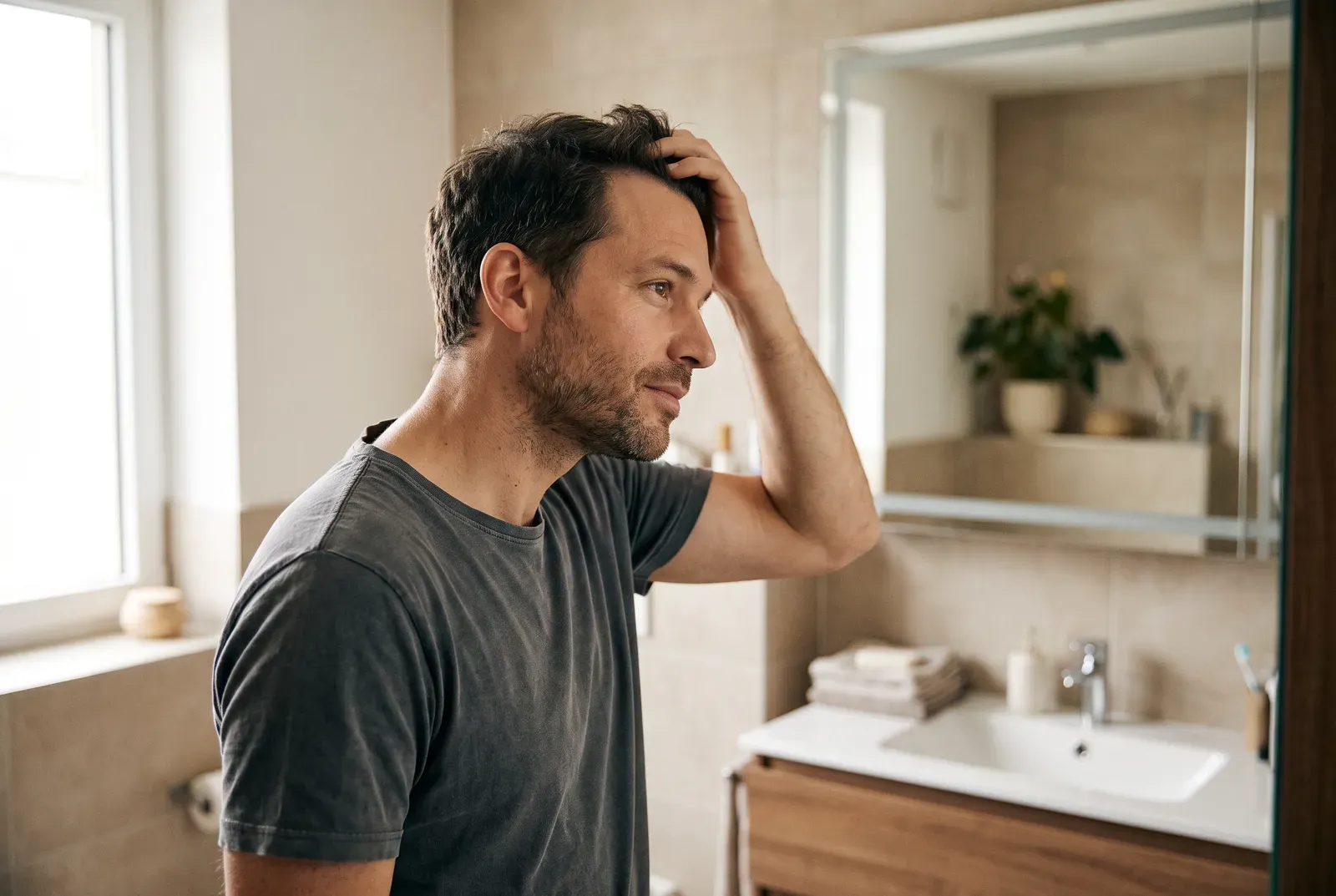



Hair loss is a physical matter, but it rarely stays there. Many people affected find that thinning hair wears on their self-esteem, weighs on their mood, and makes social situations more taxing. That is an understandable reaction and nothing to be ashamed of. For most people, hair is part of their own image of themselves, and a visible loss touches exactly that image.
This article is about the emotional side: why hair loss is a strain, how this differs between men and women, which reactions are normal, and when it makes sense to seek support. First, the most important point: this strain is common, it can usually be managed well, and when it sits deeper, there is effective help.
Why hair loss is a psychological strain
Hair is part of how we see ourselves and how we present ourselves to others. When this changes visibly, it can shake our body image, our self-esteem, and our sense of social confidence. That is why it is understandable when hair loss triggers more than a brief annoyance in front of the mirror.
The emotional impact is well studied, especially for hereditary hair loss (androgenetic alopecia), the most common and permanent form; which other forms there are is set out in Understanding hair loss. A systematic review shows that this hair loss is associated with lower satisfaction with one's body image, lower self-esteem, and a reduced quality of life. In some studies, the measured impairment of quality of life was comparable to that of severe psoriasis, and higher rates of anxiety and of depressive symptoms are also reported in those affected.1 This does not mean it is like this for everyone. It means: if it weighs on you, you are not alone in that and not overly sensitive.
Men and women experience it differently
Hair loss affects both sexes, but it is not experienced in the same way. The differences lie less in the hair itself than in what society regards as normal.
In men, hereditary hair loss often begins at a young age, and a receding hairline is considered so common that it hardly needs explaining. But this normalization does not take the strain away. Men, too, describe that the loss preoccupies them, that they worry about it progressing further, and that their self-image suffers as a result. The fact that something is common does not make it easier for the individual.
In women, hair loss is less socially anticipated. Full hair is more strongly linked with femininity, and visible thinning, usually at the parting, does not fit this image. This can increase the strain and more often comes with the feeling of having to explain oneself or hide. Men are clearly affected, but on average women suffer more from the visible loss and experience it as more significant.12 Read why hair loss shows up differently in women and what helps in the article Hair loss in women.

Common emotional reactions
Many people react to the strain in similar ways. These patterns are normal and not yet a sign of a mental illness. But it helps to know them, because over time they can take on a life of their own:
- Ruminating: The hair loss becomes a recurring theme in your mind, often with worries about it progressing further.
- Constant checking: frequently checking in the mirror, on your phone screen, or in photos, sometimes several times a day.
- Avoidance: bright light, certain hairstyles, photos, or social occasions are avoided in order not to show the scalp.
- Low mood and withdrawal: less desire for contact, more irritability, a feeling of insecurity when dealing with others.
Such reactions are human and, in themselves, no cause for concern. It becomes critical less because of the thoughts themselves than because of what they do to everyday life: when avoidance and checking take up more and more space and your room to act shrinks.
When should you seek help?
There is a transition between an understandable strain and a condition that needs treatment, and it is good to know it. The emotional strain belongs in professional, psychological, or medical hands when it becomes severe, lasts for weeks, or noticeably restricts everyday life. This is especially true when signs are added that go beyond the topic of hair: persistent low mood, hopelessness, marked anxiety, social withdrawal, or the loss of enjoyment in things that otherwise matter to you.
This is not a reason for alarm, but for a calm next step. Psychological strain can be treated, and help works. The first points of contact are your general practitioner, a psychotherapy consultation, or a psychiatric practice. This article does not replace such treatment or any medical or psychological assessment.
What helps in coping
There is no switch that turns off the strain, but a few things noticeably help many people:
- Talking about it: The loss often seems bigger as long as it stays a secret. Those who confide in a trusted person often notice that others hardly see it as critically as they do themselves.
- Checking your perspective: How much do others really notice the hair loss, and how much of it plays out in your own head? Asking this question honestly often takes off pressure.
- Shifting your focus: Deliberately direct your attention to things that do you good and have nothing to do with hair, instead of feeding the urge to check.
- Professional support: When your thoughts get stuck, psychotherapeutic support can help you find your way out of the ruminating and avoidance.
There is also an honest point to add: an effective treatment of the hair loss itself can reduce the emotional strain. Studies on hereditary hair loss suggest that in many people a visible improvement in the appearance of the hair also improves their emotional well-being.12 But this is not a guarantee of emotional well-being, and it does not replace psychological help when the strain sits deeper. Both can make sense side by side: tackling the hair loss and, where needed, tending to the emotional side in its own right.
If you want to tackle the hair loss
If you want to have the hair loss itself treated, you can have it assessed by a doctor. Whether a treatment is an option, and which one, depends on the cause, your health, and your life situation. This is determined by a medical review, not by a questionnaire alone. The earlier you look into it, the more can often be preserved; read more in the article Treating hair loss early.
With us, you answer medical questions about your health and your hair loss online, at your own pace. Our doctors check your information for suitability and possible contraindications and assess which evaluation or treatment fits you. They only prescribe a treatment if it is medically suitable; a prescription is not guaranteed. A responsible assessment also includes the fact that every medication-based treatment has its own possible side effects, which are independent of this and which the medical review discusses with you. Read how this review works in the article How the health questionnaire works.
Frequently asked questions
Is it normal for hair loss to be a psychological strain?
Yes. For most people, hair is part of their self-image, and a visible loss can affect self-esteem, mood, and the sense of social confidence. Studies show a clear association between hair loss and a lower quality of life. This strain is understandable and not vanity.
Why does my self-esteem suffer from hair loss?
For most people, hair is part of their own image of themselves and of how they present themselves to others. When this changes visibly, it touches the body image and the sense of social confidence, which is why self-esteem drops for many. Studies on hereditary hair loss confirm this association. This is an understandable reaction and not a sign of superficiality.
Can hair loss lead to depression?
Hair loss itself is not a mental illness, but it is associated with higher rates of anxiety and depressive symptoms. When low mood, hopelessness, or lack of drive persist for weeks or restrict everyday life, that should be assessed medically or by a psychotherapist. Such conditions can be treated well.
Does hair loss strain women more than men?
On average, yes. Hair loss is socially more expected in men, while in women it is less anticipated and is more often experienced as stigmatizing. In research, women suffer more on average. This does not mean that men are barely affected; they, too, often experience the loss as a strain.
What helps against the psychological strain from hair loss?
Many people are helped by talking about it openly, comparing their own perception with how others see it, and directing their attention away from constant checking. If the strain persists, psychotherapeutic support makes sense. An effective treatment of the hair loss can also reduce the strain, but it does not replace psychological help when that is needed.
When should I seek psychological help because of hair loss?
When the strain becomes severe, lasts for weeks, or restricts your everyday life, and especially with persistent low mood, hopelessness, marked anxiety, or suicidal thoughts. The first points of contact are your general practitioner, a psychotherapy practice, or a psychiatric practice. In an acute crisis, the Telefonseelsorge helpline is available around the clock free of charge on 0800 111 0 111.
Does a hair loss treatment improve emotional well-being?
In many people, well-being also improves with a visible improvement in the appearance of the hair, as studies on hereditary hair loss show. But a treatment is not a guarantee of psychological well-being, and it does not replace psychological help when the strain sits deeper. Both can make sense side by side: tackling the hair loss and tending to the emotional side in its own right.
Sources
- 1.Aukerman EL, Jafferany M (2023). The psychological consequences of androgenetic alopecia: A systematic review. https://pmc.ncbi.nlm.nih.gov/articles/PMC10084176/
- 2.Cash TF (1999). The psychosocial consequences of androgenetic alopecia: a review of the research literature. https://pubmed.ncbi.nlm.nih.gov/10583042/