


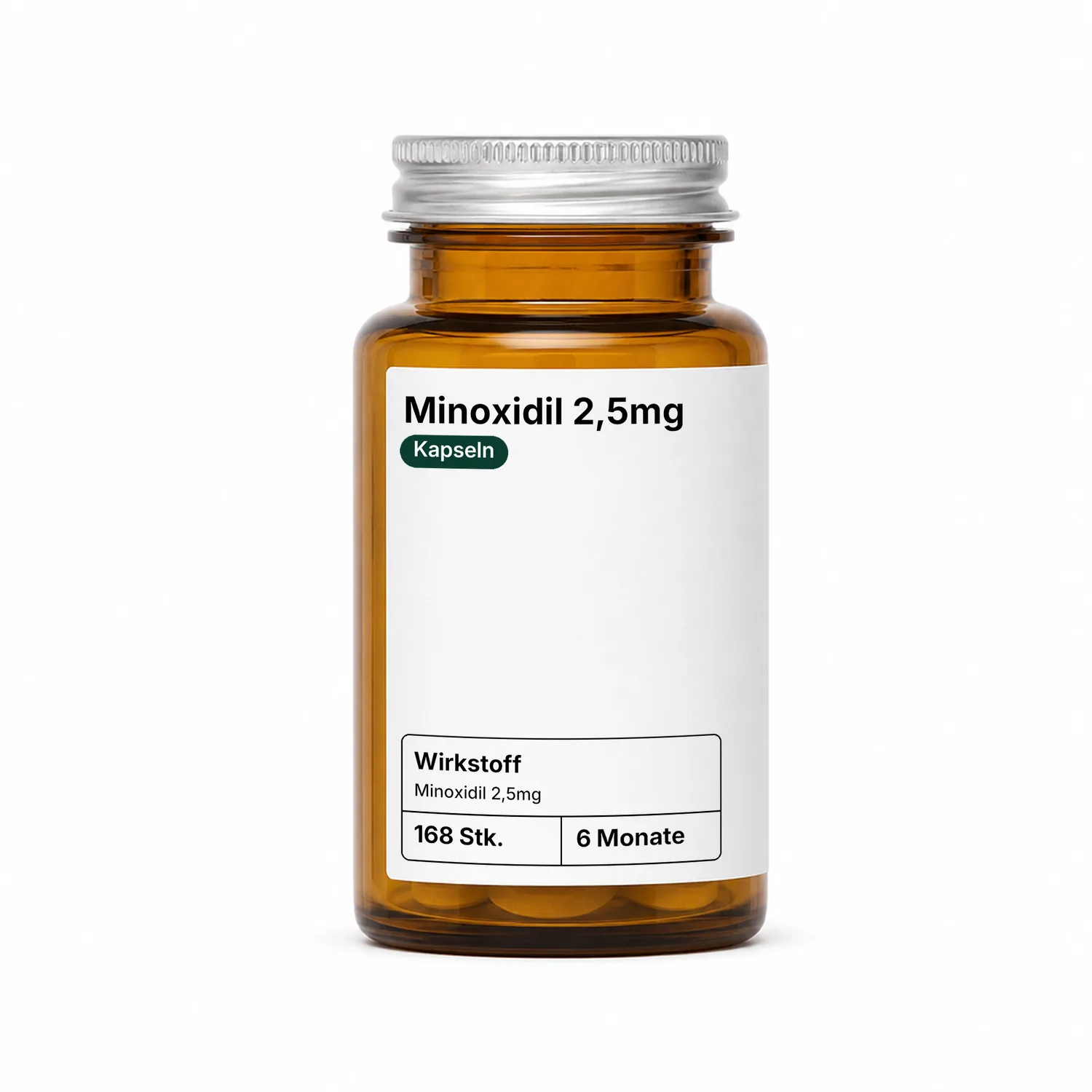
Minoxidil is one of the best-studied active ingredients against hereditary hair loss. Topically, meaning applied to the scalp, it is approved over the counter in Germany. In addition, minoxidil is available as a capsule to take by mouth (oral minoxidil): a low-dose form that may be an option off-label on prescription, for example when topical application does not help enough or is difficult to fit into everyday life. What is suitable is decided by the doctor. Minoxidil prolongs the growth phase of the hair and only works as long as you use it. The earlier you start, the more can be preserved.
How does minoxidil work?
Minoxidil is used for hereditary hair loss (androgenetic alopecia), the most common form of hair loss in men and women. You can read how this form develops under Understanding hair loss. Originally, the active ingredient did not come onto the market as a hair product but as a medication for high blood pressure. That it stimulates hair growth was noticed as a side effect in blood-pressure patients and was later used specifically for that purpose.1
Minoxidil belongs to the vasodilators, the active ingredients that widen the blood vessels. However, the exact mechanism at the hair follicle is not conclusively understood. Each hair alternates between a growth phase (anagen) and a resting phase (telogen). It is established that minoxidil opens certain potassium channels at the dermal papilla, the control centre of the hair root, and prolongs the anagen phase.2 As a result, resting follicles return to the active phase earlier, so that more hairs grow at the same time and become stronger. That the widened vessels supply the follicles with more oxygen and nutrients is regarded as a possible explanation, but is not proven to be the sole cause of hair growth.
A particular feature explains why minoxidil does not work equally well in everyone. The active ingredient is a precursor and must first be converted in the scalp by the enzyme sulfotransferase into its active form, minoxidil sulfate. How active this enzyme is in the hair follicles differs from person to person. With low enzyme activity, topical application responds less well or not at all, which explains part of the so-called non-responders.3
Important for realistic expectations: minoxidil can strengthen existing, weakened hairs and reactivate resting hair roots. It does not bring back completely dead follicles at already bald spots. This is why treatment works better the earlier it begins.
How is minoxidil used and is it approved?
There are two forms of minoxidil. Topical minoxidil for application to the scalp is approved in Germany for hereditary hair loss and available over the counter in pharmacies. Oral minoxidil, the tablet, is not approved for hair loss in Germany and is only prescribed off-label. For most people, the topical form is therefore the usual route.
In women, the 2 percent concentration is usually used, in men the 5 percent concentration.2 How often you apply it depends on the preparation and concentration. The product is applied to the dry scalp in the affected area and stays there, so it is not washed out. After applying, you wash your hands and let the treated area dry.
Oral minoxidil, the tablet, is approved in Germany only for the treatment of high blood pressure, not for hair loss. Its use against hair loss is off-label and prescription-only. Off-label means that an approved medication is prescribed outside its area of application. A doctor may do this if they consider it medically justifiable in an individual case; they weigh benefit and risk.
In pronounced hereditary hair loss, minoxidil is sometimes combined with finasteride, which acts at a different point. Whether a combination makes sense in an individual case is decided by the doctor.
Side effects
The most common with topical use are local reactions on the scalp. Redness, itching, flaking or burning are possible, often triggered by excipients such as propylene glycol.1 How well a preparation is tolerated also depends on the excipients it contains.
Other possible side effects:
- Unwanted hair growth (hypertrichosis): Increased hair growth can also occur in places other than the scalp, such as the face. With topical use this happens above all when the active ingredient reaches adjacent areas of skin. With the oral form this effect is more common, because the active ingredient acts throughout the whole body.4
- Initial increased shedding (shedding): At the start, hair loss can temporarily increase, usually within the first two to eight weeks, sometimes longer. Older hairs are shed so that new ones can grow. This is a known effect and not a sign that the treatment is not working.
- Rare systemic effects: With topical use only a little active ingredient reaches the bloodstream, so systemic side effects are rare. With the oral form, cardiovascular effects such as fluid retention, a faster pulse or dizziness are possible, because minoxidil acts on the circulation.4
Interactions and contraindications
Topical minoxidil should not be applied to an irritated, inflamed, injured or sunburned scalp, because more active ingredient can then be absorbed into the body. It must not be used in cases of known hypersensitivity to minoxidil or to one of the excipients.
Because minoxidil was originally a blood-pressure medication, caution is required in cardiovascular disease, especially with the oral form. Anyone taking heart medication or blood-pressure-lowering agents, or who has a heart condition, should have its use clarified with a doctor beforehand. Whether minoxidil is suitable in your case and whether interactions with your other medications can occur is checked by our doctors based on your health information.
Warnings
According to its approval, topical minoxidil should not be used during pregnancy and breastfeeding. The active ingredient can reach the child through the placenta and passes into breast milk. Whether a pregnancy or breastfeeding applies is clarified beforehand in the medical health questionnaire.
Minoxidil is life-threatening for cats and other pets. Even small amounts, for example from licking treated skin, towels or spilled solution, can cause severe heart and circulatory damage in cats and be fatal.5 Keep the product out of reach, wash your hands after applying, let the treated area dry, and keep your pet away from pillows and towels that may have residue on them. You can read more in the article Minoxidil and pets.
Also avoid contact with the eyes and mucous membranes. If minoxidil gets into the eye, rinse it out with plenty of water. Results take months, and the effect achieved is reversible: if you stop minoxidil, the effect wears off over several months, and hair loss continues where it would stand without treatment.
Frequently asked questions
How long does it take for minoxidil to work?
Plan for several months. The first visible changes usually appear after three to six months, and the result can often only be reliably assessed after six to twelve months of regular use. At the start, hair loss can temporarily increase. Taking stock after just a few weeks means judging too early.
Spray or capsule, which is a better fit?
Minoxidil can be applied topically as a spray to the scalp or taken off-label as a capsule. The spray works locally where you apply it. The capsule works throughout the body, is prescription-only, and is used off-label at a low dose, for example when topical application does not help sufficiently or is difficult to fit into everyday life. What may be considered depends on your situation, how well you tolerate it, and your preference, and our doctors decide this together with you.
Does minoxidil also help with a receding hairline at the temples and at the front of the hairline?
Minoxidil is best studied for the crown and vertex area at the top of the head. It can also have an effect at the front hairline and at the temples, though the effect there is often smaller. In areas that are already completely bald and where the hair roots are no longer active, minoxidil does not produce new hair.
Can I combine minoxidil and finasteride?
Minoxidil and finasteride act at different points, minoxidil on the hair cycle and finasteride on the male hormone metabolism. That is why they are sometimes combined. Whether a combination makes sense in your case is decided by a doctor. Do not combine active ingredients on your own.
What happens if I stop using minoxidil?
Minoxidil only works for as long as you use it. After you stop, the effect achieved fades over a few months, and hair loss continues to where it would be without treatment. It is best to discuss a planned discontinuation with a doctor.
Is minoxidil available without a prescription?
Topical minoxidil for application to the scalp is approved in Germany for hereditary hair loss and is available without a prescription from the pharmacy. Oral minoxidil, the tablet, is not approved for hair loss, is only prescribed off-label, and is prescription-only.
Why is minoxidil so dangerous for cats?
Cats are extremely sensitive to minoxidil. Even small amounts can cause severe heart and circulatory damage and be fatal. Store the product safely, wash your hands after applying it, and keep your pet away from treated skin, pillows, and towels. If you suspect contact, go to the vet immediately.
Sources
- 1.Badri T, et al. (2023). Minoxidil. https://www.ncbi.nlm.nih.gov/books/NBK482378/
- 2.Suchonwanit P, et al. (2019). Minoxidil and its use in hair disorders: a review. https://pmc.ncbi.nlm.nih.gov/articles/PMC6691938/
- 3.Pietrauszka K, Bergler-Czop B. (2020). Sulfotransferase SULT1A1 activity in hair follicle, a prognostic marker of response to the minoxidil treatment in patients with androgenetic alopecia: a review. https://pmc.ncbi.nlm.nih.gov/articles/PMC9326921/
- 4.Gupta AK, et al. (2023). Low-Dose Oral Minoxidil for Alopecia: A Comprehensive Review. https://pmc.ncbi.nlm.nih.gov/articles/PMC10806356/
- 5.Pet Poison Helpline (n.d.). Hair Loss Drug Can Be Deadly to Pets. https://www.petpoisonhelpline.com/toxintails/hair-loss-drug-can-be-deadly-to-pets/