

Guide
Knowledge and answers about hair loss and healthy hair.




Latest articles

Minoxidil: Prescription or Pharmacy? What Is Available Without a Prescription and What Only a Doctor Can Prescribe
In Germany, topical minoxidil up to 5 % for hereditary hair loss is available without a prescription at the pharmacy. Oral minoxidil is not approved for hair loss and is available only on a doctor's prescription. What the pharmacy may dispense and how the medical route works.
 Dr. Christian Drerup
Finasteride Experiences: What Studies Show About Progress, Response and Stopping
In large placebo-controlled studies of finasteride 1 mg, hair loss stopped in most of the men studied with mild to moderate hair loss, and in some of them the hair became denser. Plus timelines, side effects and stopping.
Dr. Christian Drerup
Minoxidil or Finasteride? Effects, Side Effects and Suitability Compared
Finasteride acts on hormones and requires a prescription in Germany. Topical minoxidil works directly at the hair follicle, is available without a prescription in Germany and comes in separate products for women as well. Which option may be suitable is clarified by a medical review.
Dr. Christian Drerup
Orales Minoxidil: Nebenwirkungen in Zahlen und wie du sie richtig einordnest
Orales Minoxidil ist gegen Haarausfall nicht zugelassen und wird off-label niedrig dosiert. In der größten Sicherheitsstudie zur niedrig dosierten Anwendung war vermehrter Körperhaarwuchs die häufigste Nebenwirkung, Kreislaufbeschwerden waren deutlich seltener.
Dr. Christian Drerup
Finasterid und Minoxidil kombinieren: Wirkung, Formen und für wen die Kombination sinnvoll ist
Finasterid senkt das Hormon DHT, Minoxidil verlängert die Wachstumsphase der Haare. Weil beide an unterschiedlichen Punkten ansetzen, werden sie bei erblich bedingtem Haarausfall oft kombiniert. Ob die Kombination für dich geeignet ist, klärt die ärztliche Prüfung.
Dr. Christian Drerup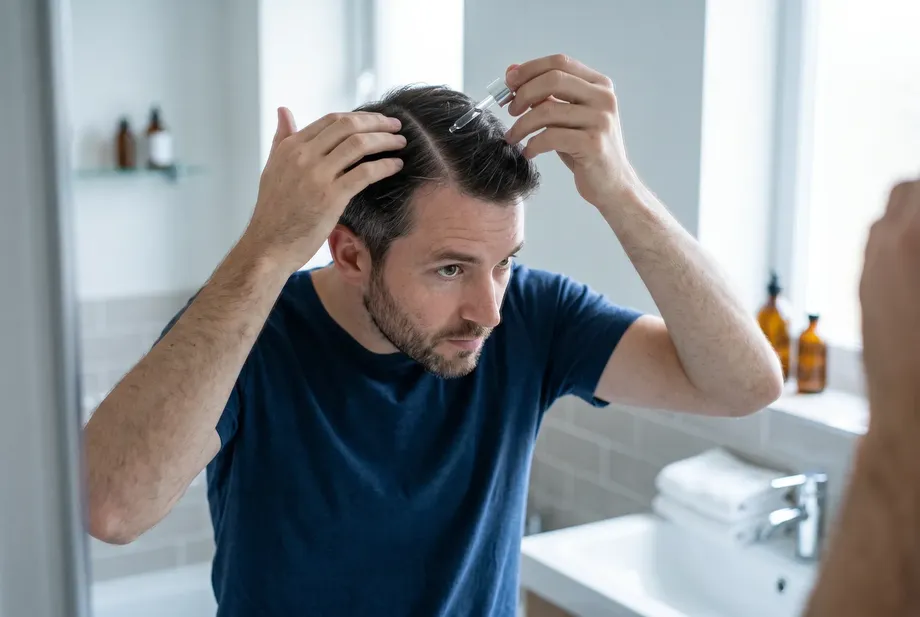
Topische Haarausfall-Lösung richtig auftragen: Anleitung für Spray und Pipette
Topische Lösungen gehören auf die trockene Kopfhaut, nicht ins Haar. Auf nasser Kopfhaut verdünnt sich die Lösung und läuft ab, dann dringt weniger Wirkstoff ein. So trägst du sie mit Spray oder Pipette richtig auf.
Dr. Christian Drerup
Finasteride: How It Works, Benefits and Side Effects
Finasteride lowers the level of the hormone DHT, which causes the hair follicles to shrink in people with a hereditary predisposition. For men with hereditary hair loss it is approved in Germany. How it works, how well this is proven and which side effects are possible, you can read here.
Dr. Christian Drerup
Spironolactone for hair loss in women: how it works, the evidence and when it may be considered
For hereditary hair loss in women, spironolactone is not approved in Germany and is used only off-label on prescription, usually together with topical minoxidil. The active ingredient is a blood-pressure-lowering medication with an antiandrogenic effect. Here is what that means for you.
Dr. Christian Drerup
Finasteride, dutasteride and trying to conceive: what applies when your partner is pregnant?
For women who are trying to conceive or are pregnant, 5-alpha-reductase inhibitors such as finasteride and dutasteride are ruled out entirely. For the man being treated, the picture is more nuanced and depends on the product and its form. What this means for you is explained here.
Dr. Christian Drerup