


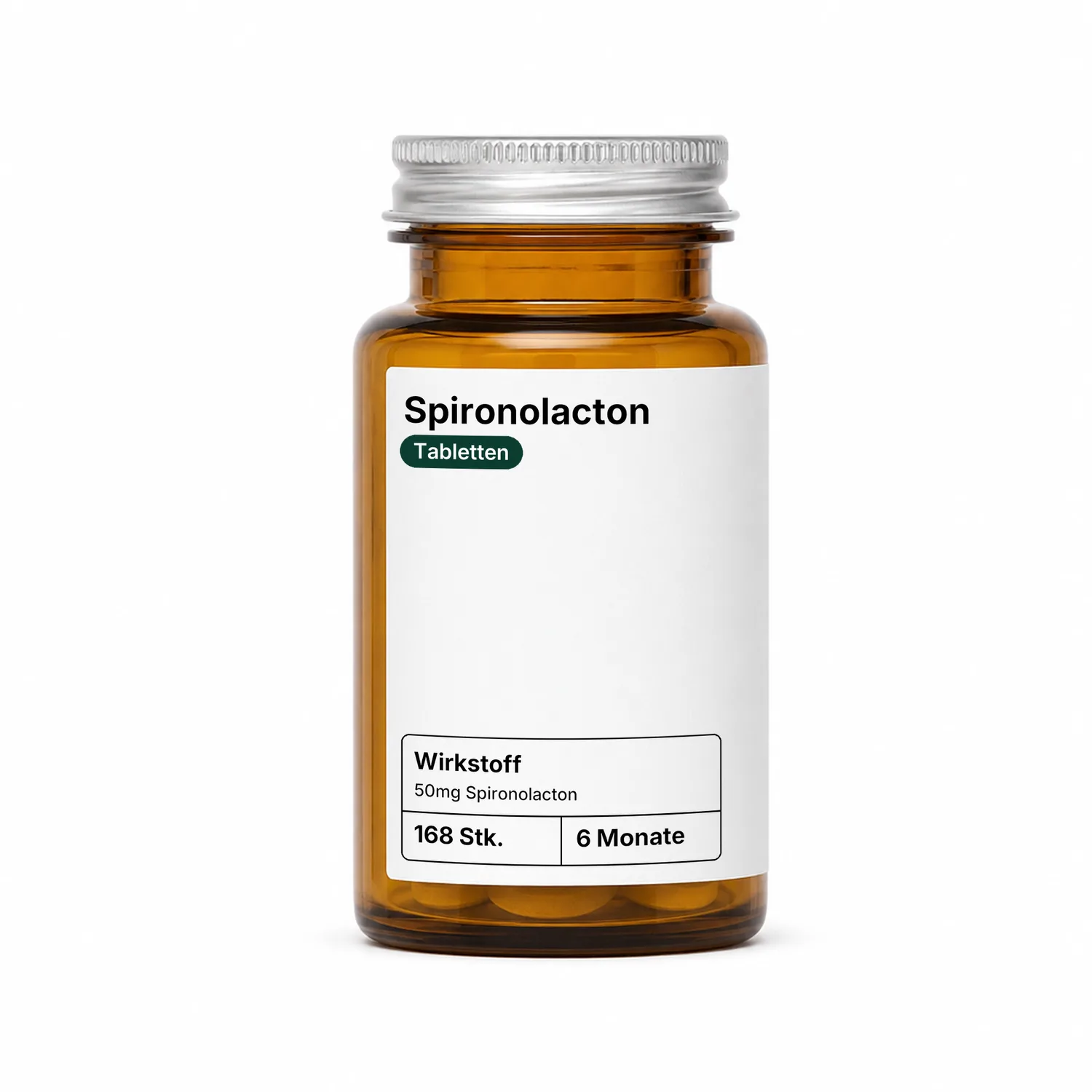
Spironolactone is an antiandrogen and is used for hereditary hair loss in women. Originally it is a diuretic medication for high blood pressure. Against hair loss it is not approved in Germany but is only prescribed off-label and on prescription, usually as a tablet and often together with minoxidil. For men it is not an option because of feminising effects.
How does spironolactone work against hair loss?
Hereditary hair loss develops when sensitive hair follicles react to male sex hormones (androgens), above all to the hormone dihydrotestosterone (DHT). DHT causes affected follicles to shrink, so that the hairs become finer and eventually fall out. You can read how this connection works under DHT and hair loss.
Spironolactone acts at this point. It blocks the androgen receptors to which the male hormones (including DHT) dock, and to a lesser extent also dampens the body's own androgen production.1 This means less hormone reaches the sensitive follicle. As an antiandrogen, spironolactone thus works differently from minoxidil, which influences the hair cycle without intervening in the hormone balance.2
Spironolactone was originally not developed as a hair product. It is an aldosterone antagonist and acts as a potassium-sparing, diuretic agent. The antiandrogenic effect is an additional effect that is used for hormone-related complaints.1 How strongly spironolactone improves hair growth at the root in detail is less clearly proven than its mechanism of action; the evidence is moderate and is classified further below.
Who is spironolactone suitable for and is it approved?
Spironolactone is an option for hereditary hair loss in women (female androgenetic alopecia). What lies behind hair loss in women and how it differs from that of men is covered by the article Hair loss in women. For men, the active ingredient is not suitable against hair loss, because its antiandrogenic effect can trigger feminising effects.
Spironolactone is approved in Germany for other areas of application, including high blood pressure, heart failure and fluid accumulation in the tissue (edema).4 Against hair loss it is not approved. Its use here is therefore off-label. Off-label means that an approved medication is prescribed outside its official area of application. A doctor may do this if it appears medically justifiable in an individual case, and weighs benefit and risk in doing so. It remains prescription-only in any case.
For female hair loss, spironolactone is taken as a tablet in a dosage set by the doctor. Whether a treatment is an option for you, which active ingredients go with it and in what form, is clarified by our doctors based on your health information. You can read what the effect and evidence look like in detail in the article Spironolactone against hair loss in women.
How well does spironolactone work?
The evidence is moderate. Spironolactone can stabilise female hair loss in many cases and improve it in some women, so it acts more to preserve than to strongly regrow.2 In one review, hair loss improved in some cases on spironolactone alone; in combination with minoxidil the treatment was more effective in studies. The results varied markedly depending on the study.3
This is why spironolactone is often combined with topical minoxidil, which acts at a different point and prolongs the growth phase of the hair. Whether a combination makes sense in an individual case is decided by the doctor.
Side effects
Because spironolactone intervenes in the hormone and salt balance, it has a different side-effect profile than a topical agent. The possible side effects include:
- Cycle and breast complaints: Menstrual disorders and a tightness or pulling in the breast occur through the antiandrogenic effect.4
- Elevated potassium (hyperkalemia): Spironolactone is potassium-sparing, so the potassium level in the blood can rise. This is the most important laboratory change and can make a check of the blood values necessary.1
- Circulatory effects: Dizziness and low blood pressure are possible, since the active ingredient is diuretic and lowers blood pressure.4
Interactions and contraindications
The potassium-sparing effect is also decisive for the interactions. Agents that likewise raise the potassium level can, together with spironolactone, trigger a dangerous hyperkalemia. These include certain blood-pressure medications such as ACE inhibitors and sartans, potassium preparations and also over-the-counter painkillers from the NSAID group, such as ibuprofen. The risk rises when kidney function is impaired.4
Spironolactone must not be used, among other cases, in pronounced kidney weakness, in already elevated potassium and in hypersensitivity to the active ingredient.4 Whether spironolactone is suitable in your case and whether it is compatible with your other medications is checked by our doctors based on your information on pre-existing conditions and medications.
Warnings
During pregnancy and breastfeeding, spironolactone must not be used. The antiandrogenic effect can lead to a feminisation of the sexual development in a male fetus.4 For women who can become pregnant, reliable contraception is important during treatment. Whether a pregnancy, a wish to have children or breastfeeding applies is clarified beforehand in the medical health questionnaire.
If you stop spironolactone, the effect wears off and hair loss continues where it would stand without treatment. A planned stop is best discussed with a doctor.
Frequently asked questions
How long does it take for spironolactone to work?
Plan for several months. First visible changes usually appear after three to six months, and the result can often only be reliably assessed after six to twelve months of regular use. Taking stock after a few weeks means judging too early.
Can spironolactone and minoxidil be combined?
Yes, the two are often combined for hair loss in women, because they act at different points. Spironolactone inhibits the effect of androgens, while minoxidil affects the hair cycle. Whether a combination makes sense in your case is decided by a doctor. Do not combine active ingredients on your own.
Spironolactone and wanting to have children, what do I need to be aware of?
Spironolactone must not be taken during pregnancy, because it can affect the sexual development of a male fetus. For women who can become pregnant, reliable contraception is important during treatment. If you want to have children, raise this with a doctor before starting.
Do I need to have my blood values checked while taking spironolactone?
It is possible. Spironolactone can raise the potassium level in the blood. For this reason, a doctor may arrange for blood and kidney values to be checked at the start and over the course of treatment, especially if kidney function is impaired or if you are taking other medicines at the same time. How closely this is monitored depends on your situation.
Is spironolactone approved for hair loss?
No. In Germany, spironolactone is approved for conditions including high blood pressure, heart failure and fluid retention, but not for hair loss. For hereditary hair loss in women, it is used off-label and is prescription-only.
Can men take spironolactone for hair loss?
No. Spironolactone is not suitable for men for hair loss, because its antiandrogenic effect can trigger feminizing effects such as breast tenderness. For men, other active ingredients may be an option.
Sources
- 1.Patibandla S, et al. (2023). Spironolactone. https://www.ncbi.nlm.nih.gov/books/NBK554421/
- 2.Rathnayake D, Sinclair R. (2010). Innovative use of spironolactone as an antiandrogen in the treatment of female pattern hair loss. https://pubmed.ncbi.nlm.nih.gov/20510769/
- 3.Aleissa M. (2023). The Efficacy and Safety of Oral Spironolactone in the Treatment of Female Pattern Hair Loss: A Systematic Review and Meta-Analysis. https://pmc.ncbi.nlm.nih.gov/articles/PMC10502763/
- 4.ratiopharm GmbH (n.d.). Prescribing information for Spironolacton-ratiopharm 50 mg/100 mg tablets. https://www.fachinfo.de/fi/pdf/010455/spironolacton-ratiopharm-r-50-mg-100-mg-tabletten